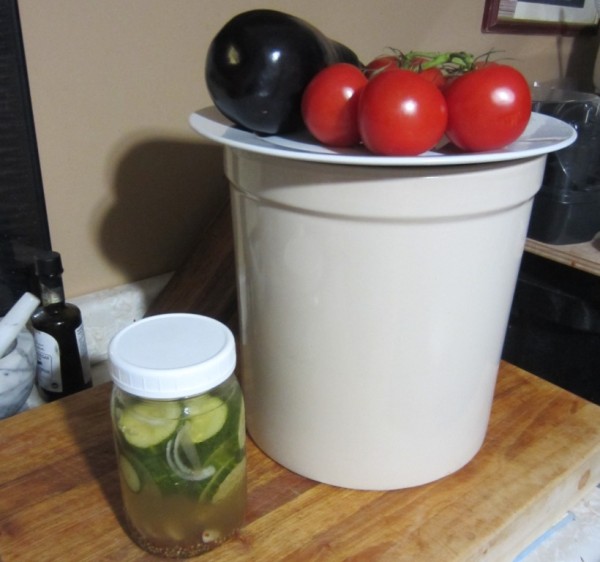
I got a call from a dear friend living down in the colonies today about her garden. It’s her first year in a new dirt space and she’s wrestling some unruly vine crops that have gotten out of hand. Tomatoes and squash and even more successfully – cucumbers. Scads of them. It’s a good year for the long green beasties which some people put down to a late summer start. Or El Nino. Or secret alien influence at pickle factories. Or dark matter spilling over from an alternative pickle-obsessed universe. Whatever the reason everyone has buckets of the things just now.
Of course you’re already eating them in salads. Certainly you’re making tzatziki by the gallon for falafel night. I lob a few into Nigella’s lovely little watermelon, feta, & black olive salad myself. I attempt some kimchi gyrations. I whizz up some gazpacho in the uber-blender. And yet, I still have extra cucumbers just begging to be used. That’s where the old-fashioned concept of a perpetual pickle crock comes in to save the summer bounty day. Anyone that’s ever had a grandmother born before 1950 with a garden probably remembers the mysterious secrets of a heavy earthenware crock quietly lurking in the darkest recesses of her kitchen. I always wondered “what exactly is going on in that thing?” Of course I might have just been an oddball grandchild.
Well let’s talk pickles. And even broader still, pickling… uhm… anything. Over-excitable food safety lackeys will whinge on about never keeping anything out at room temperature but in the grand pH scale of things, a pickle crock is easily manageable. Let’s be clear here though. These are ‘summer’ pickles. Or ‘quick’, ‘fridge’, or ‘counter top’ pickles. Or even ‘fresh’ pickles which never sounded quite right to me. Isn’t a fresh pickle a cucumber on the vine? Whatever you call them these are not preserved, ‘hot-processed’ canned pickles for long term storage. Nor are these from the curious branches of the natural fermentation movement which is making a few headlines of late. If this crock ferments, you’re going down a twisty road that leads well away from elementary pickling.
No, this is much simpler. Pickle-worthy surplus vegetables – cucumbers or any other bounty you’re harvesting at the moment – bob around in basic vinegary brine for anywhere from a few days to a few weeks, get eaten faster than you probably expect, and are replenished with fresh garden cuttings that in turn also soon disappear before your hungry eyes. Then like a pickle phoenix rising from the vinegar ashes, everything is refreshed or tossed out for the next batch in a salty, sour, and tasty loop. Your immigrant forefathers knew all about this ride.
Some people prefer to attempt this whole scheme under refrigeration. Fine by me but certainly not necessary. Archaeologists have yet to find evidence of pickled brontosaurus but otherwise pickling predates refrigerators by a few millennium I’m sure. I’m not going to bore you with safety lessons because this ‘back kitchen at the farmhouse’ method uses a seriously acidic mix that even stodgy government food agents in dark glasses say makes it fairly benign from the outset, room temperature included unless your kitchen ticks over above 80F for hours on end. I’m talking to you, Arizona trailer dwellers without air conditioning. In any event, you all hopefully have functioning noses or convenient and intimate access to someone who does. If it smells funny, don’t eat it. If it feels slimy, most definitely toss it in the bin. Let’s save the advanced kimchi and sauerkraut lessons for another day, shall we?
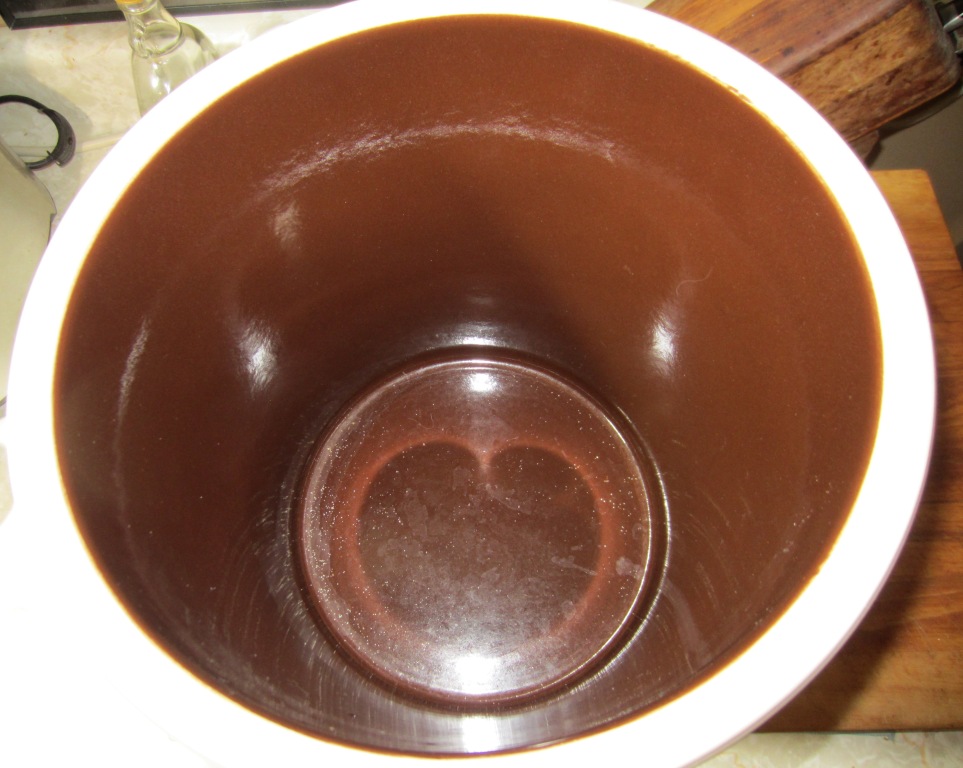
You’ll be needing a crock. A large and heavy chunk of pottery that would make a Discworld golem blush. They weigh a tonne for a reason. That helps keep everything percolating along in there cooler. Not cold mind you but you’re not going to park this vat in full sun if you’re pickle wise. A basement or a wine cellar would be great but even just the darkest corner of your kitchen will do nicely. Sure you could try to order one of these monsters online but where’s the fun in that? Go to your local swap meet or trade fair or anywhere else you find old country farmer’s wives collecting en masse over kaffeekuchen. They’re the ones that have these things kicking around the barn and back pantries from long ago. If you absolutely must buy new, every country has a stoneware manufacturer that manages to stay in business even today. Especially any local culture that traces roots back to Switzerland, Germany, or Eastern Europe will have pickle crock history for you to tap. The Amish and Mennonites are good pickling peoples indeed.
They’re usually measured in gallons and your own pickling buy-in is a personal choice. My brine history says that two gallons is too small and five is too big unless you’re really mental for pickles. The three-gallon number you see above has been a trusty companion for a while now. Don’t moan about the size it takes up in your apartment. It just sits there and you can park other stuff on top as you can see I usually do. Some pickling cult members will tell you to get ceramic weights made to keep your flotilla of vegetables below the liquid level. That sounds like a really good idea to me but I’ve never bothered. A plate and a rock (clean) might be a decent half step in that direction. Could you do this in one-litre glass jars? Sure. But the cycle I’ll explain really doesn’t lend itself well to batches under a gallon. Read on brave pickle warrior.
The recipe goes something like this:
Fill your crock loosely with veg. Don’t prep it just yet.
Fill water around the veg until covered by a couple of inches.
Remove the veg and note the water level left over. It’s probably about 60% of the total volume but it’s an easy enough test to perform. You needed to wash those cucumbers anyway, right? You now have your target brine volume.
To make the brine, use AT LEAST a 65% mix of vinegar to everything else which gives you a pH of around 3.86 assuming you’re using vinegar with 5% acetic acid by volume – the most common potency and a designation that should feature prominently on the label. Make up the rest of the volume with boiled (i.e. sterilized) water. While it’s hot, you’re going to want to stir in some salt and sugar. No rules but don’t go nuts. You can always add more. I use about half a cup of each for a two gallon batch of brine to fit my three gallon crock. Sometimes I use more. Sometimes I use less. Sometimes I leave out the sugar altogether. I’m a pickle-dexterous rebel that way. The main thing is that your acid/water ratio, and hence your pH, is in the safe zone. Salt helps a bit in the preserving process but it’s really all about the vinegar. Which vinegar? Your call. Plain white distilled. Apple cider. Fancy French champagne vinegar. Moldovan red wine and otter vinegar. Anything you want and have to hand *. Use a mix. Use what’s on sale at the megamarket in the two gallon jug. Science doesn’t care. Your taste buds might however.
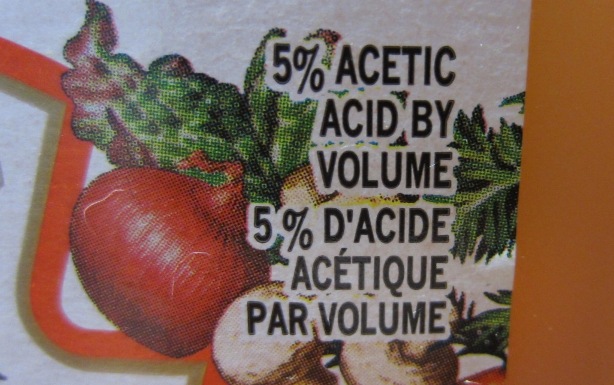
* Be aware of the pH math should you choose some oddball variety with lower than 5% acetic acid by volume. They do exist so read labels carefully and get out the calculator if necessary.
And then comes any extra kicks you fancy. Whole garlic cloves. Cracked peppercorns. Red chile flakes. Whole mustard seeds. Sliced or smashed hunks of fresh ginger root. Fresh dill heads lopped off unsuspecting plants in the garden with the seeds still inside. It’s all good. You’re going to use such relatively small amounts they likely won’t throw the pH into the danger zone but I’d avoid heaps of really leafy fresh herbs because they will go slimy quick. A bit of fresh dill weed if you must, sure, but keep most of your spicy additions on the less green side.* Use up some of those old dried herbs in the back of the cupboard that are useless elsewhere. This is ‘creative pickling’ at it’s finest so play around with the mix. And be bold. Since these pickles probably won’t soak more than a week or two, you’d have a hard time overpowering them with extra flavour spikes.
*A curious exception to this rule might be young grape leaves. They were historically added to pickle crocks because of a natural ‘firming’ effect from an enzyme inhibitor present in the leaves. And they make awesome dolmas later.
When the brine mix has cooled, drop in your prepped vegetables. Washed and thinly trimmed of their blossom ends, whole cucumbers work well if they’re not too huge. In this method, I’m a fan of good old slices. You can certainly use ‘field’ cucumbers and decide for yourself if you want to partially peel them for texture but that will result in a softer inner pickle quicker. Try saying that ten times fast. Not really a problem if you’re going to eat them inside a week. Thin-skinned English cukes work great if you leave the skins completely intact and cut rounds in a variety of thicknesses. Thinner for early in the week, thicker for the weekend pickle party. They all start to taste good in just a few days and you can gauge the most opportune time to dip into the crock for a jolt of sour taste next to your burger. Wait a few more days and they follow a sort of bell curve of intensity, peaking at about a week and then mellowing with their remaining week or two in the mix, if they last that long.
“Hang on, you said ‘perpetual pickles’ there Spork. What gives?” With this method, I am a master of pickle rotation management (PRM, Ha! I just made that up.) The way it works generally is that the pickled parts of your crock will actually sink below fresh bits you add as you eat through the fruits of your labour. For example, if I’ve eaten two cucumber’s worth of the six I originally tossed in by Wednesday, I’ll toss two more back in so they’ll be ready by the time I finish off the other four. You’ll become an expert at identifying which have been in for a while and which are new pickle recruits. You’ll also become well versed at spoon-crock navigation. Buy a long handle. Trust me.
But here’s where it gets tricky. New veg introduces new liquid to the mix that isn’t acidic. That’s bad pH mojo but since we started with 65% vinegar, there’s some wiggle room here before we get into any danger zone. Usually the pros in the lab don’t even flinch until you drop below a 50% solution (pH 4.6)*. As your brine with all the extra bits of goodness you tossed in cures a while, the pickles really start to taste amazing quicker and quicker even though they’re in the spicy bath for relatively shorter times. I keep this rotation of new veg up for probably three weeks then I call time out and stop adding new pickle candidates and just finish off whatever stragglers remain. After two more weeks I move anything left into glass jars with non-metallic lids so I can park them in the fridge making sure that I finish those off in a week or two more. You can see on the left in the main photo up top that I experiment around with the effect cold storage has on them that way with very interesting results.
* Remember, different vinegar has different percentages of acetic acid so this math can vary. Calculate for yourself to be sure.
“That’s still not perpetual, you pickle oil salesman!” Stop yelling at the screen and settle down pickle rookie. I’m not done. Remember why I stopped the Large Hadron Pickle Collider? The acid was dropping too low. My remaining pickle lake is usually in very good shape and delivers lovely taste after all the flavours have melded into greater than the parts. After a bit of judicious straining or scooping and some brief simmering on the stove top to clean things up, I install a heavy dose of fresh vinegar to get the acid balance back where I want and begin the whole routine over again with a jump start from the previous batch. You could whip out your Little Junior Chemistry set and test for pH but I do it by taste and experience. If you assume your left over brine is still at least somewhat acidic you can do some complicated acid calculus or hire a professional pickle scientist in a lab coat to sort out how much vinegar to add. Or you could just toss the whole thing out and start over from scratch if you’re nervous about poisoning the dinner guests. “I’m sorry ma’am, it was Colonel Mustard, in the kitchen, with the pickle.”
“Hey Pickled-Jedi-Master, this all started because we have a few bountiful weeks in summer. I can’t do this in October can I?” Well spotted, Jar-Jar. Free your mind from the cucumber chains and imagine what else you can toss in your magic crock all year long. My own three gallon pickle ranch is never just cucumbers, it’s a pickled cornucopia up in there. Those whole garlic cloves you tossed in at the beginning taste great after three weeks. I usually add extra just to have them at the end of a cycle. There’s rarely a batch of cucumbers that doesn’t have companion red or sweet onions sliced along for the ride. Peppers? Any sort from whole mild Hungarian cherry to stacks of jalapenos cut into rings work like a charm. Cauliflower florets go into a pickled Italian classic called giardiniera. Pickled okra with hot chile flakes gets parked in the middle of Cajun and Creole tables almost automatically. Baby carrots? You bet. Adult carrots sliced into sticks even. Small or sliced beets work too if you don’t mind the funky colours after. The only things to avoid with this paleo-picking approach are particularly soft or wet ingredients. While tasty when made with other recipes, don’t try to pickle beans, asparagus, eggs, or tomatoes (green or otherwise) with this technique. If it’s crunchy raw, it’ll probably work as a crock pickle.
Getting the idea here? Just realize that you won’t get as heavy a pickled taste with this approach as compared to a cooked hot-process. It’ll be more fresh vinegar pop and if you sample them in the first two days, they’ll probably knock you back a few steps making you wonder what that mad Canadian on the internet has gotten you into. Go to your Zen pantry and give them time to do their pickle-y thing. And try not to eat the whole lot on day five when you realize you too are now a master pickle crock wrangler like those generations who pickled before you. Of course you can also heat process anything properly at then end of a stint in the dark corner but honestly, none of the goodness in my crock ever lasts long enough for that to happen. I eat it all long before there’s a chance to spoil.
My friend down south that started me on this pickling rant has made overtones of getting her own crock after I espoused the glory of my own. We’ll see if she makes good on her future pickle promise. Long before she became the Queen of Bountiful Cucumberville, she sent me this bit of pickle humour from elsewhere on the web. Read it, laugh, then get thee to a crockery.
If I had a lawyer looking over my shoulder right now, I’m sure he’d make me say you pickle at your own risk. Nothing contained in this rant should be taken as definitive food safety advice. But then again, I’m not dead yet and I’ve had a pickle crock for decades. Your pickle mileage may vary.