Samosas are perfect little portable treats beloved in their native India and Central Asia but also anywhere culinary cross-pollination has taken them around the globe. They’re tender and flaky pyramid-shaped pastries filled with spicy potato or other veg that, when exported to the west, are often supplemented with ground meats and local tweaks to spicing. You can get hot-from-the-fryer offerings at push carts that populate most any overcrowded urban jungle of tropical latitudes or pre-packaged convenience examples from the corner markets of any London neighbourhood although I’d recommend the former over anything from a cold plastic box. No pale Scottish pasty, these little delights get a shot of vigour from chiles, ginger, cinnamon, cumin, and the like. A real dance of flavour with as many permutations as there are kitchens in Mumbai and Tashkent. And conveniently you can fit one in each hand as you walk down the street. Three if you’re good at juggling. The hardest part is getting someone to follow you around with mint chutney which compliments them perfectly.
I’ve made samosas myself ever since a group of friends in my old neighbourhood decided to find “the city’s best samosa” during a particularly strong communal Indian food craving one boozy night. We sampled at least twenty from all over town for the next month and never quite found a single contender that hit all the marks. Sometimes the dough was too greasy, sometimes the filling was too heavy, sometimes it was not enough spice. The closest we found to ideal came from one of our crew’s own mother’s kitchen and she didn’t have any plans to open up a stall anytime soon. She was also ruthless in keeping her culinary secrets safe (even from her not-so-kitchen-adept daughter) so I took what lessons I could sneak from around the corner of her fridge and developed my own formula.
After seeing Felicity Cloake’s article on samosas in her “how to make the perfect…” series this week, I was reminded of how good they are and I started thinking about an easy version that could feature the same flavours but take advantage of a nearby kitchen table should you not need the portability of the traditional examples. I thought “Why not use the same sort of filling and spices but work them into a properly-sized pie with ready made puff pastry as an easy crust?” and that’s exactly what I did. The results speak volumes of traditional samosa taste in barely an hour with no fiddly dough forming or oil frying needed.
Everyone should make puff pastry from scratch. Once. After that you realize that it’s simply not worth all the effort and labour as long as you have a quality packet from your grocery. The frozen foods aisle will do nicely as the pastry really suffers no ill effects from a reasonable time in cold storage. Avoid those made with Frankenstein hydrogenated fats and stick to all-butter versions and no one will ever know the difference. It’ll be our little secret. Or park it in between two ‘regular’ pie crusts you whack together yourself in minutes using the food processor.
The ingredients for the masala, which simply means ‘mix’ with the implication of spices, read like an overly long laundry list to some but the interplay between each component is worth the trouble of keeping a deep inventory. Committed carnivores can easily add lamb mince to the filling at the beginning if they must but the vegetarian version won’t leave anyone wanting for flavour.
One Big Samosa (aka Samosa as Pie)
For the masala:
3 whole cloves
1/4 teaspoon whole cardamom seeds (removed from pods)
1 teaspoon whole cumin seeds
1 teaspoon whole black peppercorns
1/2 teaspoon brown or black mustard seeds (or substitute/mix nigella seeds)
1/2 teaspoon cinnamon
1 teaspoon ground coriander seeds
1 teaspoon turmeric powder
1 teaspoon sweet paprika
In a dry skillet over medium heat, toast the cloves, cardamom, cumin, & peppercorn until fragrant, about three minutes. Remove and set aside. In the same pan toast the mustard seeds just until they begin to pop, usually less than a minute, and set aside. Once cool, grind all but the mustard seeds with the remaining spices in a small electric mill. Stir the whole mustard seeds into the mix.
Note: after grinding this will likely yield more than needed for the recipe below. Any extra is great in potato, cauliflower, or other root vegetable recipes as well as a seasoning for grilled lamb & chicken when mixed with a touch of oil.
For the Filling:
2 – 3 tablespoons of masala (above)
2 tablespoons butter
225g mushrooms, washed and finely minced (or 350g lamb mince if feeding carnivores)
3 cloves freshly peeled garlic, finely minced
20 grams (about 2 inches) fresh ginger root, peeled and finely minced
2 medium chiles, any variety to your heat preference, stems and seeds removed and finely minced
1 large yellow onion, finely diced
1 leek, finely diced
1 stalk celery, finely diced
650g (about four medium) russet or similar potatoes, peeled and cut into 1″ dice
2 large carrots, peeled and cut into 1/2″ dice
3/4 cup fresh or frozen sweet peas, whole or 1/2 head savoy cabbage, chopped (or both!)
1 small bunch coriander leaf (cilantro), finely minced
fine sea salt to taste
1 tablespoon nutritional yeast (or 1 cup stock of any make)
1 tablespoon cornstarch
To Finish:
Ready-made puff pastry to cover baking dish (all butter versions preferred)
2 tablespoons butter, melted
Plain yogurt, mint chutney, tzatziki, or a similar combination for serving
Yield: One samosa “pie” the size of your chosen baking dish
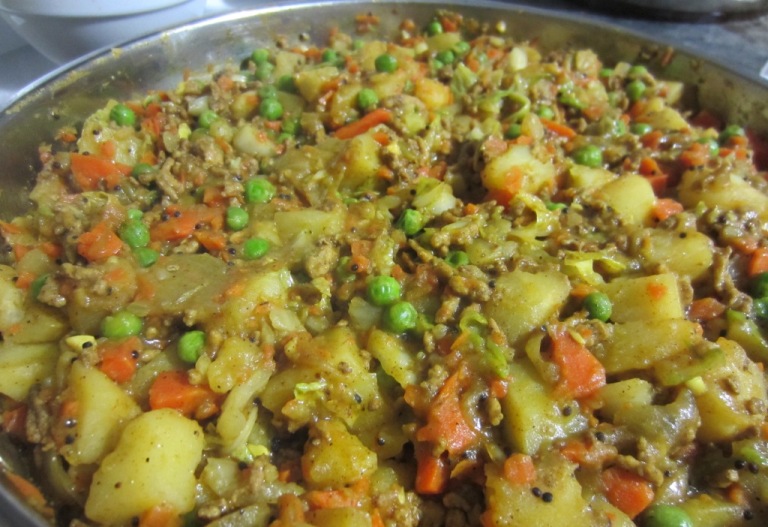
In a large skillet over medium heat, melt the butter and add masala depending on your spice preference. Saute until fragrant, about a minute. Add the mushrooms (or lamb) and cook until well coated in the spices, about two minutes, and then add the garlic, ginger, chiles, yellow onion, leek, and celery. Saute until the onions are translucent, about four minutes. Add the potato and carrot with enough water to prevent scorching, about 250ml (1 cup). Taste and adjust salt as desired. Cover and simmer until the carrots are almost tender, about fifteen minutes longer. Dissolve the cornstarch and nutritional yeast into 150ml (3/4 cup) of cold water (or stock) and pour over the mixture. Simmer until the sauce begins to thicken, about two minutes, then remove from heat and fold in peas or cabbage and coriander leaf.
At this point if you were feeling traditional you could make a simple dough enriched with butter or oil and form traditional samosas using this as filling after it cools. Normally they would be fried in oil but there are successful baked recipes out there too. My super lazy and extra quick method puts it all under one crust. You could also just skip the crust entirely and serve it over rice but that wouldn’t be very samosa of you.
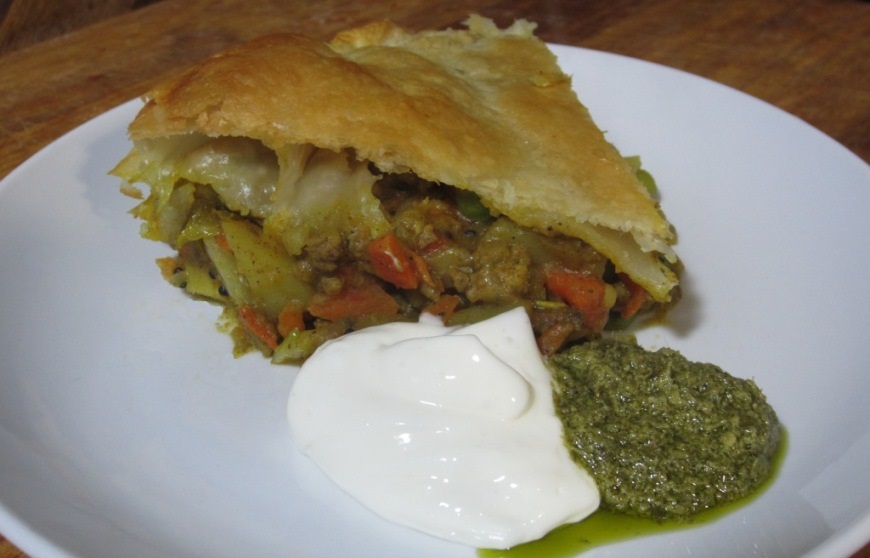
Move the mixture to an oven-safe baking dish of roughly 9″ square dimensions. Any size will do and only really changes the crust to filling ratio to your liking. Top with the puff pastry, tucking the edges under, and brush with melted butter. Bake at 375F (190C) for thirty minutes or until the pastry is golden brown. Remove and cool at least fifteen minutes before serving on hot plates garnished with yogurt and mint chutney.
V.1.1